Dual-use by design: Critical minerals corridors and the Arctic sovereignty rationale
A cluster of proposed road, port, and power projects in the Northwest Territories and Nunavut are being justified simultaneously as economic, defence, and sovereignty infrastructure.
TL;DR
- Northern roads, ports and power systems can support both mineral development and Canada’s Arctic presence.
- Dual-use infrastructure can improve project economics, but economic and defence rationales do not automatically align.
- Projects should be judged by national and regional benefits, Indigenous partnership and long-term sustainability.
YELLOWKNIFE.Three projects referred to Canada's Major Projects Office illustrate a shift in how Ottawa is framing northern infrastructure: the Grays Bay Road and Port project, the Arctic Economic and Security Corridor, and the Taltson Hydro Expansion Project. None is framed by government as a defence project alone, or an economic project alone — each is presented, in federal and industry material, as serving multiple purposes at once.
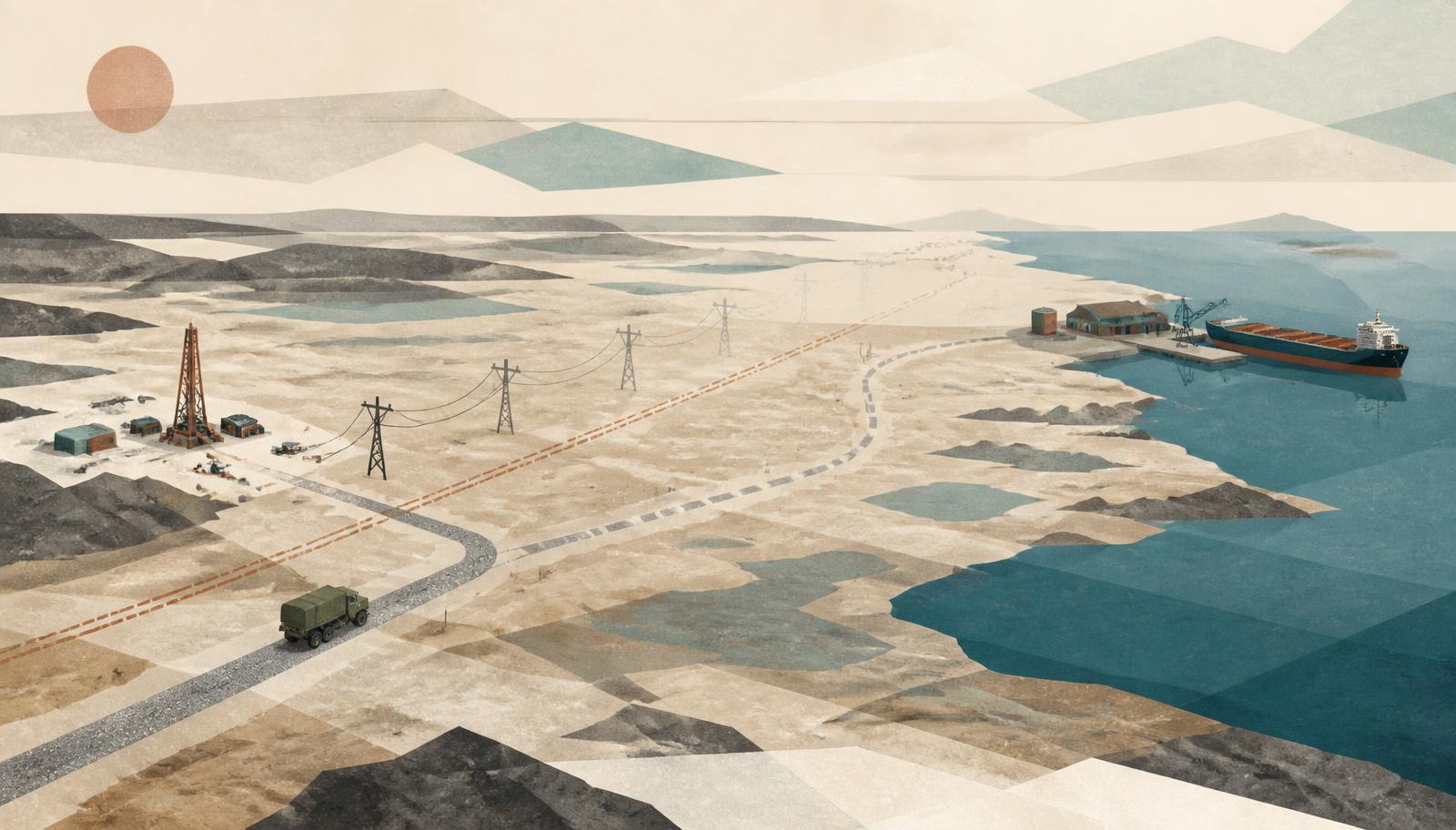
The Arctic Economic and Security Corridor, as described in federal and industry sources, is a proposed all-weather road of roughly 230 to 400 kilometres connecting the Northwest Territories to a new deep-water port at Grays Bay on Nunavut's Arctic coast, with potential construction beginning by 2030 and a projected cost exceeding $1 billion. The Prime Minister's Office has described the corridor as creating Canada's first overland connection from the national highway system to a deepwater Arctic port, intended to connect strategic mineral deposits — copper, zinc, gold, and rare earth elements among them — to national and global markets while also, in the government's stated framing, enhancing northern sovereignty and providing dual-use infrastructure for both commercial and military purposes. Currently, mineral exports from the region require routing through southern Canadian ports, adding substantial distance and cost.
The Taltson Hydro Expansion Project would add 60 megawatts of capacity to the Northwest Territories' hydroelectric system — effectively doubling it — via a 320-kilometre transmission line connecting the North and South Slave Lake grids, addressing a long-standing constraint on northern economic development: the absence of reliable, affordable power capable of supporting large-scale mining or processing activity without reliance on diesel generation.
This dual-use framing is not incidental language. Canada's 2026 Defence Industrial Strategy, released in February of that year, explicitly identifies northern and Arctic infrastructure as “currently stretched and insufficient” for the combined scale of military, industrial, and civilian activity the government anticipates, and designates critical minerals development as offering, in the strategy's own words, growth potential that directly strengthens national security — treating economic and defence infrastructure as functionally linked rather than separate categories of spending. The Canadian Critical Minerals Strategy, published by Natural Resources Canada, similarly frames northern transportation investment as serving Arctic sovereignty, national security, and reconciliation with Indigenous peoples simultaneously, alongside its stated goal of supplying minerals required for Canada's 2050 net-zero commitments.
This convergence raises a genuine analytical question rather than a settled one: infrastructure justified on multiple grounds at once can be a sign of coherent, efficiently sequenced policy — building one road that serves mining, communities, and defence logistics is plausibly more efficient than building three separate ones — or it can be a sign that no single rationale is, on its own, judged sufficient to justify the capital cost, so multiple rationales are stacked to strengthen the case. Nothing in the public record definitively resolves which dynamic is at work in the Arctic Economic and Security Corridor specifically. What is verifiable is that all three projects remain in feasibility, planning, or early referral stages rather than under construction, that the corridor's own timeline anticipates a 2030 construction start at the earliest, and that Indigenous consultation is named as a requirement in federal critical minerals materials without yet being documented, in public sources, as complete for any of the three projects.
The projects are also a useful test of the lesson Ottawa says it drew from the Nanisivik Naval Facility, where Minister Blair acknowledged that early planning failed to sufficiently weigh community benefit. Grays Bay, the Arctic Economic and Security Corridor, and Taltson are each being framed publicly as community- and economically-beneficial by design, not as afterthoughts to a defence rationale. Whether that framing holds through the more difficult stages of financing, construction, and long-term operation — where Nanisivik's difficulties actually emerged — is not yet demonstrated. It is, at this stage, still a claim rather than a completed record.
Sources
- Torys LLP, “Canada's Arctic moment: realizing critical mineral development in Canada's North” (2026)
- Investor Ideas, “Canada's North Emerges as Critical Minerals and Infrastructure Hub” (2026)
- CIM Magazine, “Critical minerals key highlight in Canada's first defence strategy” (2026)
- Natural Resources Canada, “The Canadian Critical Minerals Strategy”
Researched and written by Nowrth staff writers, working from federal department publications, parliamentary and committee records, and peer-reviewed and parliamentary research. Nowrth publishes research and analysis under a collective byline.