Two jets, one question: What kind of air force does Canada actually need?
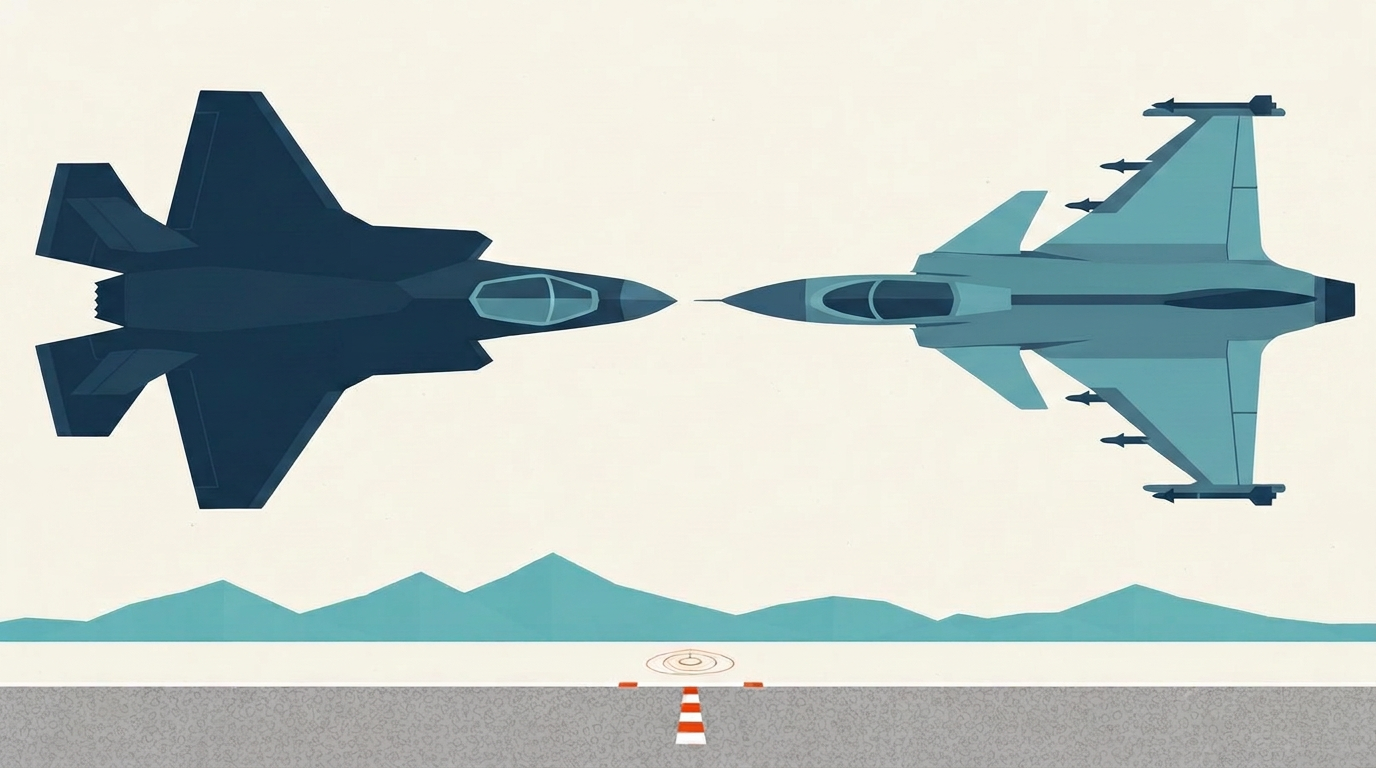
With Ottawa's review of the F-35 procurement still open, the comparison with Saab's Gripen E is less a contest between airframes than a question about the mission, the basing model and the industrial relationships Canada is choosing for the next four decades.
TL;DR
- Canada’s fighter review is about more than comparing the F-35A and Gripen E as aircraft.
- The choice also shapes basing, interoperability, industrial relationships and the way Canada intends to operate in the Arctic.
- Neither option answers the larger question of what kind of air force Canada wants to sustain over the next four decades.
OTTAWA.Canada finalized its agreement for 88 Lockheed Martin F-35A fighters in early 2023, ending more than a decade of competition to replace the aging CF-18 Hornet fleet. It appeared, at the time, to close the file. Instead, in March 2025 — shortly after taking office — Prime Minister Mark Carney ordered a review of the procurement, citing the deterioration of trade relations with Washington and Canada's exposure to U.S.-controlled defence supply chains. More than a year later, that review has no announced conclusion, and the pause has reopened a question many in the defence community considered settled: the F-35 alone, or some other arrangement?
The “something else” is Saab's JAS 39 Gripen E, a Swedish-built 4.5-generation fighter that lost the original Canadian competition but has re-emerged as a serious contender. Saab has pitched Ottawa on 72 Gripen E aircraft plus six GlobalEye surveillance planes, built around a promise of roughly 12,600 Canadian jobs, potential local assembly through a partnership with Bombardier, and even a sovereign data centre in Montreal — pitched as a way for Canada to control its own mission data rather than route it through American systems, as the F-35's architecture requires.
The case built into the airframe
What distinguishes the F-35 is not simply that it is newer. It is a fifth-generation aircraft designed around low observability: its shape, seams and surface materials are engineered to minimize radar return, and its sensor-fusion architecture presents pilots with an integrated picture of the battlespace that earlier fighters cannot replicate. That capability carries real costs. The F-35's radar-absorbent materials are built into its composite skin rather than applied as a coating, which makes them more durable than those of earlier stealth aircraft — but repairing them after damage requires specialized low-observable maintenance teams, engineering validation, and in more complex cases direct involvement from Lockheed Martin. U.S. Air Force maintenance units describe the work — masking panels, mixing coatings, inspecting large numbers of fasteners — as slow and exacting. U.S. Government Accountability Office reporting has put mission-capable rates for the global F-35 fleet near 55% in recent years; critics of the program cite that figure, while program officials attribute it to the normal maturation curve of a still-expanding fleet. None of this is disqualifying on its own. It does, however, make the F-35 an aircraft best suited to hardened, well-resourced main operating bases rather than dispersed, austere ones — a consideration with direct relevance to northern operations.
The opposite assumption
The Gripen was designed around almost the opposite assumption. Sweden built it to survive a war in which its home air bases might be destroyed in the opening hours — which meant designing a jet that could disperse to short stretches of highway, gravel strips, or, in Canada's case, potentially ice runways and remote northern airfields, serviced by a small ground crew without a purpose-built hangar. Saab and its advocates cite operating costs well under half of the F-35's per-flight-hour figure. It is not a fifth-generation aircraft, and it lacks the F-35's sensor fusion and low-observable profile — a gap Canadian analyst Richard Shimooka has argued disqualifies it outright for a country with NORAD and NATO obligations, warning that a mixed fleet would leave Canadian pilots with reduced situational awareness next to allied F-35 squadrons. Other defence-policy voices, including the Canadian Global Affairs Institute's David Perry, frame the review less as a capability question and more as a predictable reaction to an ally whose reliability suddenly looks less certain than it did a decade ago. The Royal Canadian Air Force itself, according to multiple reports, has continued to favour the F-35 internally, while Industry Minister Mélanie Joly has raised the economic and sovereignty case for the Gripen — a split that runs through the review as much as any technical comparison does.
The question underneath
Setting aside the politics, the underlying question is structural: does Canada require the most capable fighter available on the market, or the fighter best matched to the specific problem of defending a vast, thinly populated and increasingly contested Arctic? The evidence presented so far suggests those may not be the same aircraft — though it is equally possible that Canada's NORAD and NATO commitments leave little practical alternative to full interoperability with the allied F-35 fleet. The procurement is also, less visibly, a decision about industrial alignment: a purchase of this scale will tie Canada's air force to one supplier's logistics, software and sustainment systems for roughly forty years. Whether the review ultimately reaffirms the original decision, modifies it, or produces a mixed arrangement, its outcome will say as much about how Canada sees its defence relationships over that horizon as it does about either aircraft.
Sources
- Reuters/Yahoo Finance, “Exclusive-Canada defense review makes case for sticking with F-35 jets, sources say”
- Global News, “F-35 review ‘understandable’ for many, but would it risk Canada's security?”
- Army Recognition, “Canada considers purchasing 72 Swedish Gripen fighters alongside U.S. F-35s in 140-fighter mixed fleet” (2026)
- The Hub, “Canada's Gripen gamble: 90% of defence contracts will stay in a broken system” (2026)
- SimpleFlying, “Why F-35 Operators Cannot Perform Their Own Stealth Coating Maintenance Without Lockheed Martin's Direct Involvement”
- Tyndall Air Force Base Public Affairs, “Tyndall's LO Airmen protect F-35 stealth capabilities”
- 19FortyFive, “Gut Punch: Canada Wanted the F-35 But the Price Spiked and the JAS 39 Gripen Looks Great On Paper” (2026)
Researched and written by Nowrth staff writers, working from federal department publications, parliamentary and committee records, and peer-reviewed and parliamentary research. Nowrth publishes research and analysis under a collective byline.