Canadian waters: The Northwest Passage and the work of holding it
Canada's position on the Northwest Passage has been settled for four decades. The waters of the Arctic Archipelago are internal waters, held through historic title and the 1986 straight baselines. The longer task is keeping a working presence in them, and the Arctic sets its own pace for that work.
TL;DR
- Canada's official position is that all waters of the Canadian Arctic Archipelago, including the Northwest Passage, are internal waters of Canada and subject to its full sovereignty.
- The claim rests on historic title rooted in Inuit use and occupancy over thousands of years, and on the straight baselines Canada drew around the archipelago in 1986.
- As a matter of policy, Canada permits international navigation provided foreign vessels meet Canadian requirements for safety and environmental protection.
- Making the legal position visible is long-horizon work, from dual-use infrastructure to the terrain knowledge of the Canadian Rangers.
OTTAWA.Canada's position on the Northwest Passage has been settled for four decades, and it has not changed. According to Global Affairs Canada and successive federal policy frameworks, all of the waters of the Canadian Arctic Archipelago are internal waters of Canada. That includes every channel that makes up the Northwest Passage. In Canadian law and policy, these waters are sovereign territory in the same sense as the land between them.
The claim rests on two foundations. The first is historic title. Canada holds that its title to these waters grows out of the long occupancy and use of the ice by Inuit, who have hunted and travelled across the region for thousands of years. That record is central to the legal position, and successive governments have cited Inuit presence as a core foundation of Canadian Arctic sovereignty. The second foundation is the system of straight baselines. In 1986, Canada drew an unbroken perimeter of baselines around the outermost edges of its Arctic islands. Under international maritime law, waters landward of such baselines are internal waters. Canada treats everything enclosed by the Arctic baselines accordingly.
The classification carries real consequences. Because Canada defines these waters as internal, it regulates them as it regulates land. It sets environmental protections and shipping safety standards, and it can deny entry to foreign vessels outright. Canada has exercised that authority for decades. The Arctic Waters Pollution Prevention Act of 1970 dates from the era when the position was first put to the test, and mandatory reporting under the Northern Canada Vessel Traffic Services Zone Regulations continues today under the Canada Shipping Act. Internationally, Article 234 of the UN Convention on the Law of the Sea recognizes the right of coastal states to adopt and enforce pollution-prevention rules in ice-covered waters within their exclusive economic zone.
It is a matter of public record that the United States and the European Union characterize the passage differently, regarding it as an international strait. Canada has never accepted that characterization, and the disagreement has been managed pragmatically rather than litigated. Under the 1988 Arctic Cooperation Agreement, the United States undertakes to seek Canada's consent before its icebreakers transit the passage. Cooperation on navigation proceeds while Canada's position stays intact. Canadian maritime policy follows the same logic in practice. Canada permits international transit, provided foreign vessels comply with Canadian safety and security rules.
From position to presence
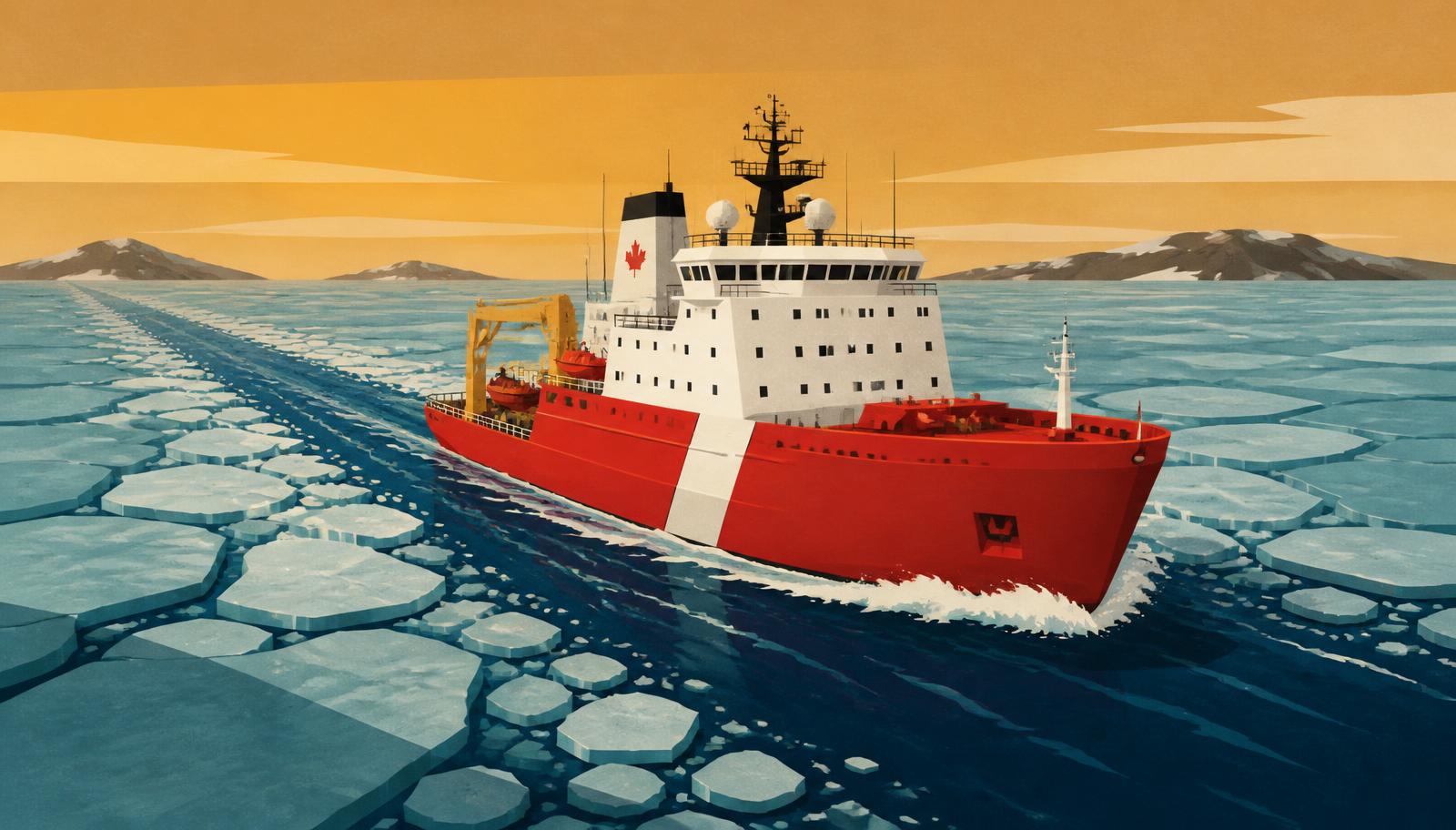
The next layer of the strategy is physical. Our North, Strong and Free, the 2024 defence policy update, commits Canada to a series of northern investments. These include operational support hubs in the territorial North and over-the-horizon radar to narrow long-standing surveillance gaps, all within a NORAD modernization program valued at $38.6 billion over two decades. The Harry DeWolf-class Arctic and offshore patrol ships have begun putting a recurring naval presence into waters that historically saw little of one. Operation NANOOK continues to train Canadian Armed Forces personnel in High Arctic conditions alongside allied partners and northern communities. The urgency is real. The Arctic is warming roughly four times faster than the global average, and the navigable season is lengthening. The pace of construction, however, is set by the geography itself. A building season can be measured in weeks. Permafrost complicates every foundation. Distances multiply the cost of every tonne of material, and winter caps the working year. Northern infrastructure is a multi-year engineering undertaking planned around the environment. Sovereignty asserted this way accumulates slowly, through patient and cumulative work.
Dual use, and the economics of presence
One design principle does much of the work of making that build-out affordable: dual-use infrastructure, planned from the outset to serve defence and civilian purposes alike. A runway lengthened for strategic airlift also carries scheduled passenger flights and medical evacuations. A harbour built to receive naval vessels also supports community resupply. The model has found support on both sides of the ledger. For the Department of National Defence, it stretches each operations and exercise dollar further by anchoring military activity in facilities that exist and function year-round. Territorial governments and Indigenous and northern leaders, who have long advocated the approach, point to the other side of the exchange. Defence spending leaves the North with assets communities actually use. In practical terms, dual use is what makes a sustained military presence financially viable in a region where everything costs more.
The people who know the ground
Equipment does not assert sovereignty on its own. People do. The Canadian Rangers, the Canadian Armed Forces' community-based reserve component, patrol and report across a territory larger than most countries. The force is drawn from the communities it serves, and most of its members are Inuit or other Indigenous peoples, bringing an asset no sensor replicates: an intimate knowledge of the terrain and ice of the regions they cover. Successive governments have described the Rangers as the eyes and ears of the North, and exercises such as Operation NANOOK are built around that partnership. The 2024 policy commits to expanding the force. The broader modernization program is best understood as an effort to connect that human knowledge to new technology, from radar to undersea sensing, so that each reinforces the other.
The Northwest Passage, then, presents Canada with a legal position that is settled and a physical presence that must be continuously built. The elements are in place. The claim is clear. International navigation is handled in an orderly and predictable way. The construction program now underway is being sized to the geography it must serve. The question the coming decade will answer is how deeply that sovereignty comes to be written into the ports and communities of the Arctic Archipelago.
Sources
- Department of National Defence, “Our North, Strong and Free: A Renewed Vision for Canada's Defence” (2024)
- Global Affairs Canada, “Canada's Arctic Foreign Policy” (2024)
- Canadian Armed Forces, “Operation NANOOK”
- Department of National Defence, “Canadian Rangers”
- CBC News, “Nanisivik Naval Facility still has no opening date” (March 2025)
- The Arctic Institute, “Canada's National Shipbuilding Procurement Strategy: New Capabilities for Arctic”
Researched and written by Nowrth staff writers, working from federal department publications, parliamentary and committee records, and peer-reviewed and parliamentary research. Nowrth publishes research and analysis under a collective byline.