Reading the Prime Minister's tariff address: Reassurance, candour, and a new iron spine
Mark Carney's latest Forward Guidance video pairs an unusually frank admission of cost with a longer argument about national structure. The most consequential passage may be a single metaphor.
TL;DR
- The Prime Minister’s address acknowledged that tariffs carry real costs while presenting them as part of a wider economic transition.
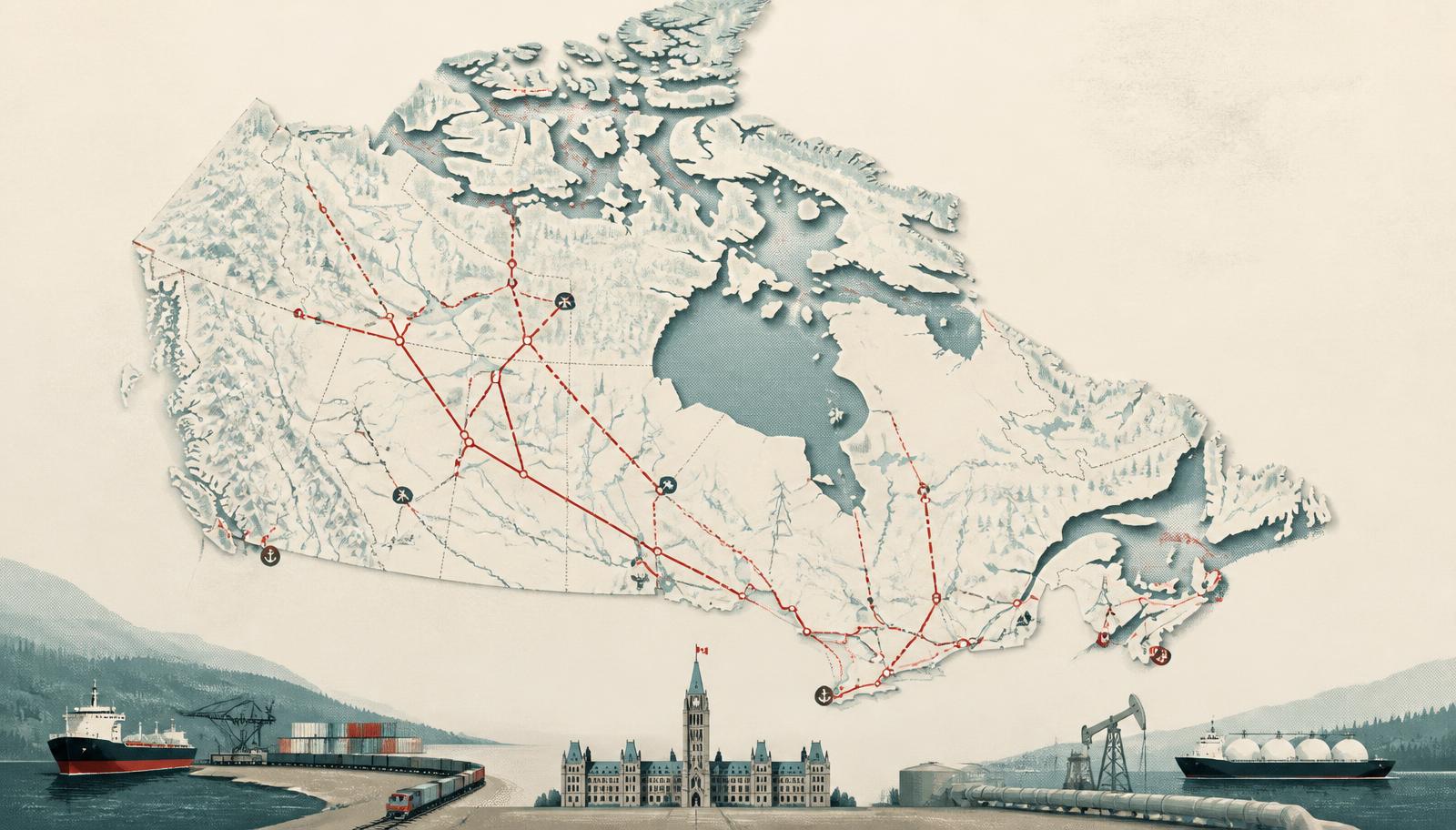
- His “new iron spine” referred to infrastructure connecting Canada north to south, building on the railway as a national metaphor.
- The policy test is whether long-term projects can turn reassurance into durable economic capacity.
OTTAWA.Prime Minister Mark Carney's latest Forward Guidance video, released September 8 within hours of Canada's retaliatory tariffs taking effect, runs roughly fifteen minutes and was filmed on the floor of Caivan, a factory-built housing company. The setting is not incidental. The address is built around a deliberate contrast: acknowledgment that the trade conflict with the United States will impose real costs on Canadian workers and businesses, set against an argument that the policy response is already taking physical, measurable form — in housing factories, mines, and trade corridors rather than in communiqués alone.
The factual core of the address is straightforward. Canada's counter-tariffs, ranging from 15 to 50 per cent, are calibrated to match the dollar value of the American measures — roughly $27.6 billion in goods — and apply only to products on the U.S. list. The Prime Minister framed them as necessary rather than aggressive, saying explicitly that he does not believe in escalating the conflict, but that Canadian goods cannot face charges at the border while American goods enter tariff-free. He also announced $7.5 billion in new support for the sectors bearing the brunt of the dispute — automotive, forestry, steel, and aluminum — on top of approximately $25 billion in measures already deployed.
What distinguishes the address from routine crisis communication is its candour about trade-offs. “That pivot will come at a cost,” the Prime Minister said of the reorientation away from the U.S. market. “There's always a cost to action. But it doesn't come close to the cost of standing still.” This is a notably unvarnished formulation for a sitting government, and it deserves to be read as such: an admission, rather than a denial, that households and firms will feel the adjustment. Whether the support package is sized to the actual exposure of the affected sectors is a question the address leaves open, and it is the question economists and the opposition have both seized on.
The address also reached for history, comparing the current moment to the McKinley tariff of 1890, which imposed 50 per cent duties on Canadian exports and was intended, in the Prime Minister's telling, to pressure Canada toward dependence and eventual annexation. The episode instead pushed Canada to diversify its trading relationships, while the United States experienced rising inflation and a multi-year depression. The parallel is rhetorically effective, though it should be held with some care: the Canadian economy of 1890 was far less integrated with the American economy than today's, and the adjustment path available then — building an east-west national economy behind tariff walls — is precisely the strategy being proposed again, in modernized form.
It is in this structural argument that the address contains what may be its most consequential passage, and the one most relevant to readers of this publication. Recalling the Canadian Pacific Railway as the “iron spine” that once bound the country from east to west, the Prime Minister gave the metaphor a new direction:
“Now we are developing around it, north and south. A new iron spine, with an electric grid that connects each and every one of us.”
The phrase inverts the usual geography of Canadian nation-building. The canonical spine — the CPR, the Trans-Canada, the St. Lawrence corridor — runs east to west, binding the provinces to one another. A spine running north and south describes something different: corridors and transmission connecting Arctic ports, northern resource regions, and territorial economies to southern markets and supply chains. Read against this government's recent policy record — the Northern Operational Support Hubs, dual-use infrastructure framing in the 2024 defence policy update, and sustained attention to critical minerals corridors — the metaphor is consistent with a genuine reorientation of federal capital spending toward the north–south axis. Whether it survives contact with the estimates process is, as ever in northern policy, the operative question.
Reaction has tracked familiar lines. Conservative Leader Pierre Poilievre had already called, in late August, for the release of the full text of the U.S. offer the government rejected and for Parliament to be recalled ahead of its scheduled September 21 return, arguing that Canadians cannot judge costs they have not been shown — a legitimate accountability demand, whatever its partisan framing. The address did not answer it. That the government's own framing concedes a cost, while the opposition's central objection is about disclosure rather than direction, suggests the disagreement is narrower than the volume of it implies.
The measured reading, then, is neither alarm nor applause. The government has been unusually honest that the pivot will hurt; it has matched that honesty with substantial, if not obviously sufficient, fiscal support; and it has articulated a structural ambition — a new iron spine running north and south — that aligns with the northern policy files this publication tracks. The honest tests are all ahead of it: whether Parliament is given the details the opposition is demanding, whether the $7.5 billion reaches affected workers at the speed the rhetoric implies, and whether the spine is built as infrastructure rather than invoked as imagery. Fifteen minutes of candour is a good foundation. It is not yet a structure.
Sources
- Prime Minister of Canada, “Forward Guidance: A Stronger Canada” video address (September 8, 2026)
- The Canadian Press, “Carney warns of tough times ahead in national address as retaliatory tariffs begin” (September 8, 2026)
- Winnipeg Free Press, “Text of Prime Minister Mark Carney's ‘Forward Guidance' video” (September 8, 2026)
- Canada Border Services Agency, Customs Notice — United States Surtax Order (2026)
Researched and written by Nowrth staff writers, working from federal department publications, parliamentary and committee records, and peer-reviewed and parliamentary research. Nowrth publishes research and analysis under a collective byline.