An alliance without a name: What Canada's flirtation with EU associate membership could mean for the North
Reporting suggests Ottawa is scoping out arrangements with Brussels short of full membership. The details are developing, but the defence and Arctic dimensions are already on the record.
TL;DR
- Canada is exploring a closer relationship with the European Union, but no formal associate-membership model has been proposed.
- Canada already participates in the EU’s SAFE defence procurement programme as its first non-European participant.
- Any deeper arrangement could affect Arctic security, defence supply chains and support for Ukraine, but the details remain unsettled.
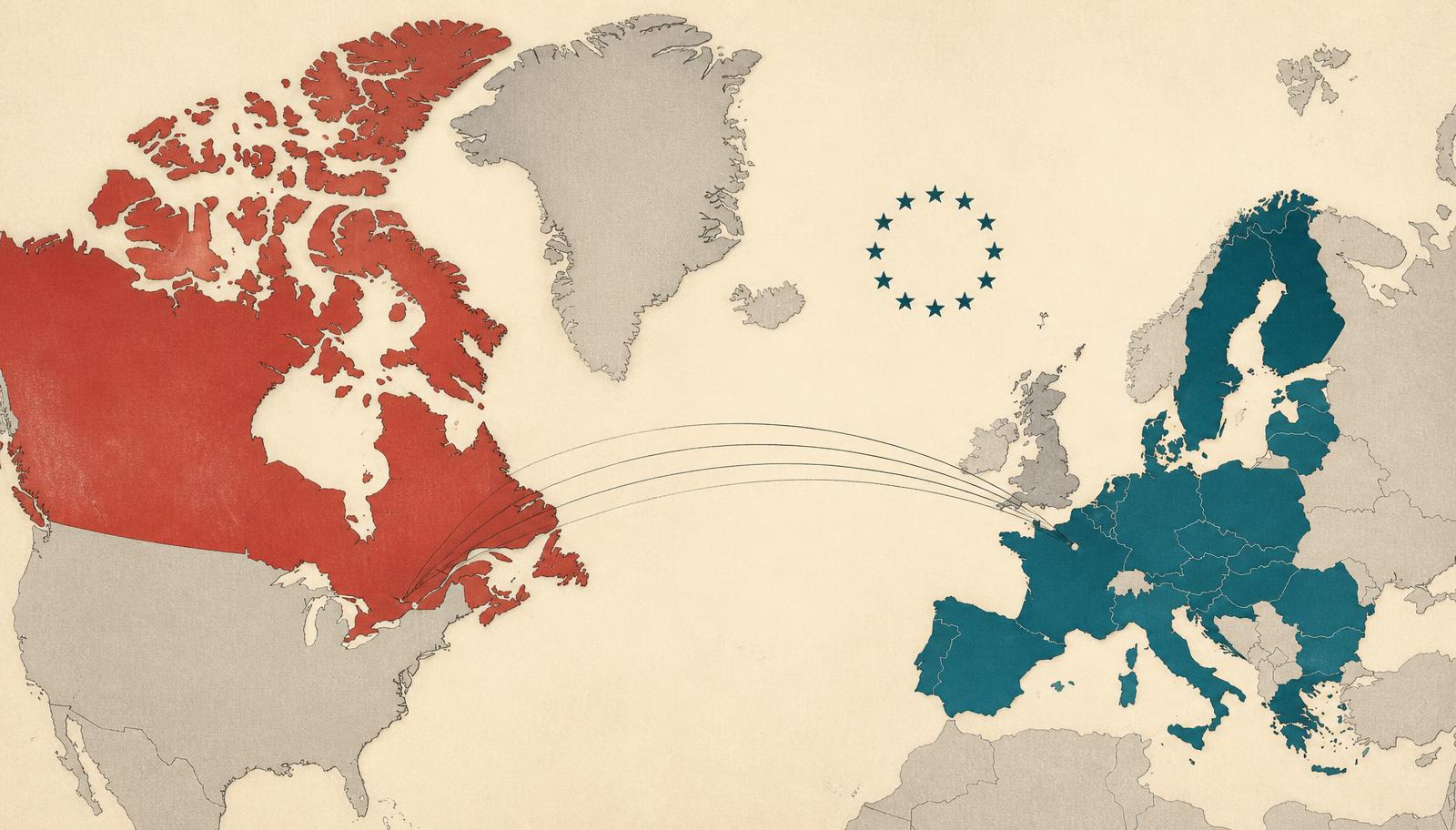
OTTAWA.A Wall Street Journal report on September 13 described an effort inside the Prime Minister's Office to explore a form of Canadian association with the European Union falling short of accession. According to that reporting, since relayed by Reuters and the BBC, Mark Carney “has instructed his special envoy to Europe to scope out the most ambitious possibilities short of full membership in the EU or its common market.” That envoy is John Hannaford, appointed the Prime Minister's Personal Representative to the European Union in October 2025. The phrase “associate member” has travelled quickly, but it is worth stating at the outset what it is and is not: it is a characterisation drawn from reporting on internal discussions, not a treaty category, not a Commission proposal, and not language Ottawa has adopted in any published document. The file is developing, and readers should treat the shape of it as unsettled.
What is on the record is narrower and more useful. Speaking to reporters in Toronto on September 13, the Prime Minister declined the membership framing and offered his own:
“What we are looking — and will begin discussions for — [is] a unique alliance with the European Union.”
The Prime Minister's Office struck a similar register the previous day, announcing his travel to Strasbourg and Liverpool with the line that Canada and Europe “are bound by shared history, values, and increasingly shared interests and ambitions.” Those are the authoritative texts available at the time of writing. A speech to the European Parliament was scheduled for the same week, and a Canada–EU summit hosted by Canada is expected in late October; both will supply firmer material than the current reporting does.
The part that is already built
The speculative headline sits on top of a concrete and documented arrangement. In December 2025 EU member states endorsed an agreement for Canada to participate in the EU's Security Action for Europe instrument — SAFE — a €150 billion loan facility for defence procurement created under the bloc's Readiness 2030 plan. Canada formally joined in February 2026 and remains, on the Government of Canada's own description, the first and only non-European country admitted. In June 2026 the first contract under the agreement went to Montreal-based Marconi Technologies — a roughly $10 million radio supply deal with Poland's cyber command.
The colloquial shorthand for SAFE in Canadian coverage has been the EU's “defence bank” or “loans-for-weapons” programme. That shorthand is imprecise in a way that matters. SAFE is a borrowing instrument administered by the European Commission, which raises capital against the EU budget and lends it to participating states for joint procurement; it is not a standing institution with a balance sheet of its own, and Canadian participation confers access to procurement consortia rather than a seat at an EU decision table. The distinction is the difference between market access for Canadian defence industry — which is what the government has claimed — and a share of EU sovereignty, which no one has claimed.
Why the Arctic is the hinge
For a northern readership the relevant question is what any deeper association would mean for Arctic security, and here the answer is more inferential than documented. Three lines are visible. First, the alliance politics: at the July 2026 NATO summit Canada committed to helping lead the alliance's Multinational Division North alongside Latvia and Denmark, and the government has framed the Arctic as a theatre it intends to take full responsibility for. Second, the European side is itself in motion — the Commission has been reworking its Arctic approach, with EU leaders meeting in Finland in September on shipping, resources and security in the region. Third, the industrial logic: northern surveillance, satellite communications, icebreaking and dual-use infrastructure are precisely the categories where European procurement demand and Canadian northern requirements overlap, and where a financing instrument like SAFE could plausibly reduce the unit cost of capability Canada intends to buy regardless.
None of that requires associate membership. It is worth being clear that the Arctic benefits under discussion are largely available through the partnerships Canada has already signed — the 2025 Security and Defence Partnership and the SAFE accession. What a broader association would add is durability: a standing framework less dependent on the disposition of any single government on either side of the Atlantic. That is a real argument, and it is also the hardest one to verify in advance.
Ukraine, and the price of the room
Canada's support for Ukraine is the clearest evidence that the Canada–EU security relationship is operational rather than declaratory, and it is also the file where association would be tested first. The Prime Minister's Strasbourg visit coincided with the return of the Russian frozen-assets question to the EU agenda — a debate about whether and how immobilised sovereign assets can finance Ukrainian reconstruction and defence. Canada has legislated in this area ahead of several EU member states. Closer association would mean sitting nearer to a decision Canada does not get to make, with a corresponding expectation of alignment. Whether Ottawa regards that as leverage or as exposure is not yet publicly answered.
What to watch
Three tests will clarify the file faster than further reporting on internal deliberations. Whether the European Parliament address or the October summit communiqué contains any institutional language at all, or only partnership language. Whether the SAFE relationship is extended — additional tranches, Canadian participation in consortia, or northern-specific procurement lines. And whether Parliament is given a framework document to examine, since an arrangement that binds Canadian procurement and sanctions policy to a European process is one the estimates and committee record should be able to trace. Until then, the honest description of the situation is the Prime Minister's own: discussions that have not yet begun, toward an alliance that does not yet have a name.
Sources
- Prime Minister of Canada, “Prime Minister Carney to strengthen Canada's ties with European partners in visit to Strasbourg and Liverpool” (September 12, 2026)
- BBC News, “Carney eyes ‘unique alliance’ with EU as trade war with US intensifies” (September 14, 2026)
- Reuters, “Carney pushes idea of making Canada ‘associate member’ of EU, WSJ reports” (September 13, 2026)
- The Wall Street Journal, “Mark Carney's Audacious Bid to Make Canada an ‘Associate Member’ of the EU” (September 2026)
- Global Affairs Canada, Agreement between the European Union and Canada concerning participation under the SAFE Instrument
- Prime Minister of Canada, “Prime Minister Carney secures Canada's participation in the European Union's SAFE initiative” (December 1, 2025)
- Prime Minister of Canada, “Prime Minister Carney secures new defence partnerships at the 2026 NATO Summit” (July 8, 2026)
- European Commission, Security Action for Europe (SAFE) Regulation and Readiness 2030 plan documentation
- EUobserver, “Canada's Carney attends von der Leyen's State of the Union as new talks on Russian frozen assets for Ukraine return to EU agenda” (September 14, 2026)
Researched and written by Nowrth staff writers, working from federal department publications, parliamentary and committee records, and peer-reviewed and parliamentary research. Nowrth publishes research and analysis under a collective byline.