Twenty years and counting: The Ring of Fire's unresolved timeline
Northern Ontario's chromite and nickel deposits were identified as strategically significant nearly two decades ago. Roads to the site are still under construction, amid active legal challenges from First Nations.
TL;DR
- The Ring of Fire’s strategic mineral potential has been discussed for nearly two decades, but access roads remain unfinished.
- Infrastructure planning continues alongside active legal and consultation questions involving First Nations.
- The timeline depends as much on governance, consent and sequencing as it does on mineral demand.
THUNDER BAY.The Ring of Fire, a mineral-rich area of northern Ontario roughly 540 kilometres north of Thunder Bay, holds deposits of chromite, nickel, and other critical minerals that independent estimates have valued as high as $60 billion, with Ontario government projections citing potential GDP contributions near $25 billion and roughly 5,500 jobs. The region sits within Treaty No. 9 territory and overlaps the traditional lands of nine Matawa First Nations, a fact that has shaped nearly every stage of the project's history since exploration intensified in the late 2000s.
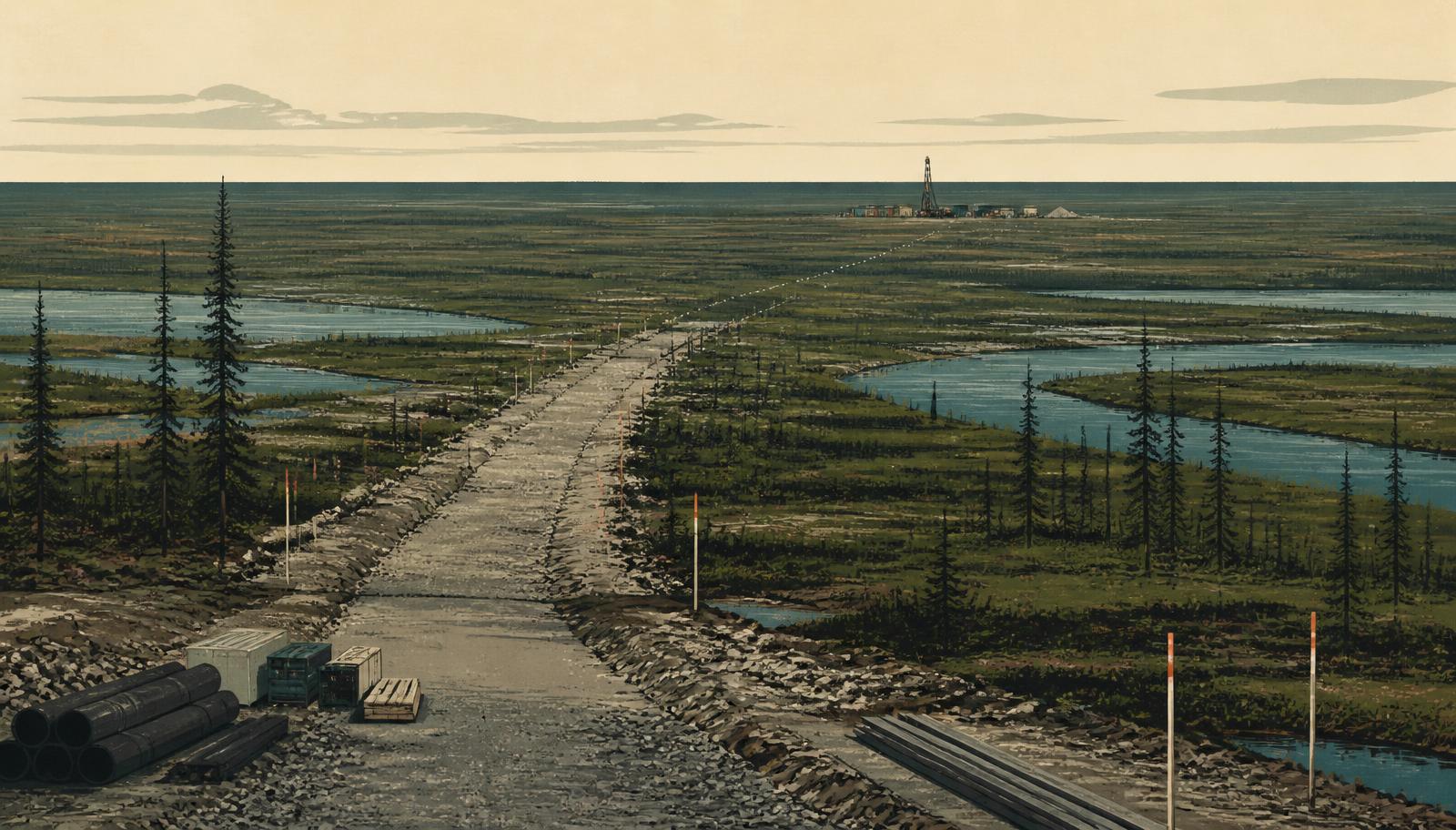
The core practical obstacle has been infrastructure. The Ring of Fire's mineral deposits sit in roadless muskeg wetlands with no existing highway, rail, or grid connection, and Ontario has committed close to $1 billion toward roughly 360 kilometres of proposed all-season roads to change that. In 2020, the province, Marten Falls First Nation, and Webequie First Nation agreed to jointly plan the Northern Road Link and connecting community access roads. Construction had still not meaningfully begun as of 2025. In March 2026, Ontario announced an accelerated schedule moving construction start dates up by as much as five years, with road-building now targeted to begin in 2026 and initial segments open by 2030 — a revision to a timeline that has itself been revised multiple times since 2020.
Regulatory and legal developments have moved in parallel. Ontario's 2025 Protect Ontario by Unleashing Our Economy Act, and its companion “One Project, One Process” initiative, are intended to consolidate provincial approvals into a single coordinated review, with a stated goal of cutting review times by half. A federal-provincial cooperation agreement pursues a similar “one project, one review, one decision” approach to reduce duplication between federal and provincial environmental assessments; the federal Impact Assessment Agency's review of the Eagle's Nest nickel project, the region's most advanced individual mine proposal, was targeted to conclude by June 2026, and the federal government subsequently decided not to designate Eagle's Nest for a full federal impact assessment. Several First Nations have filed legal challenges against Ontario's fast-track legislation, and the Mushkegowuk Council of Chiefs passed a resolution in July 2025 declaring the Ring of Fire a protected homeland requiring free, prior, and informed consent before any development-related activity proceeds — a standard that goes beyond the consultation obligations Ontario's streamlined process is designed around. A January 2026 interim report from the federal Impact Assessment Agency noted that some participating First Nations had been unable to fully engage in the regional assessment process due to inadequate resourcing for their own technical review capacity.
Wyloo Metals, which controls the Eagle's Nest deposit, has stated a target of beginning construction in 2027 and reaching production by 2030, contingent on road completion; independent observers cited in industry press coverage consider 2032–2034 a more realistic window given the project's dependence on infrastructure that has not yet broken ground. A 2024 industry survey cited by the Public Policy Forum ranked permitting delays as the single largest barrier facing Canadian critical minerals projects generally, with a lack of infrastructure in remote regions close behind — both factors squarely present in the Ring of Fire's twenty-year history from initial exploration interest to a still-unbuilt access road.
Assessed against the four-criteria standard, the Ring of Fire is the clearest case in this section of a project where the answer to all four questions remains genuinely open rather than resolved in either direction. National and regional benefit are plausible in scale, given the size of the estimated deposits, but entirely unrealized to date. Indigenous inclusion is contested rather than settled: some Matawa First Nations have signed development agreements, while the Mushkegowuk Council has taken the position that consent, not consultation, is the applicable standard, and litigation over Ontario's fast-track authority remains unresolved. Sustainability is disputed on ecological grounds specifically because of the peatlands' carbon-sequestration value, a factor less present in the Arctic tundra case studies elsewhere in this section. Two decades after the deposits were first identified as strategically significant, the Ring of Fire remains a demonstration of how long the distance can be between a mineral resource being called critical and a mine actually operating.
Sources
- Public Policy Forum, “What are critical minerals and the Ring of Fire?” (2025)
- McCarthy Tétrault, “Northern Ontario's Ring of Fire: Key Infrastructure Milestones from 2025” and “Situation Critical: Recent Developments in Canadian Critical Minerals Policy” (2026)
- Advance United, “Ring of Fire Mining Region: Ontario Critical Minerals Map” (2026)
- The Energy Mix, “Ring of Fire Push Pits Critical Minerals Against Carbon Peatlands, Indigenous Rights” (2026)
Researched and written by Nowrth staff writers, working from federal department publications, parliamentary and committee records, and peer-reviewed and parliamentary research. Nowrth publishes research and analysis under a collective byline.