A small mine with a different model: Nechalacho and Indigenous-led operations
The Northwest Territories' first rare earth mine is small by commercial standards, but it is the first in Canada where an Indigenous-owned company runs the mining operation itself.
TL;DR
- Nechalacho became Canada’s first rare-earth mine with an Indigenous-owned company operating the mine itself.
- Its small scale limits direct comparison with larger northern projects, but its operating model is significant.
- The project tests whether Indigenous participation can extend from consultation and contracting into operational leadership.
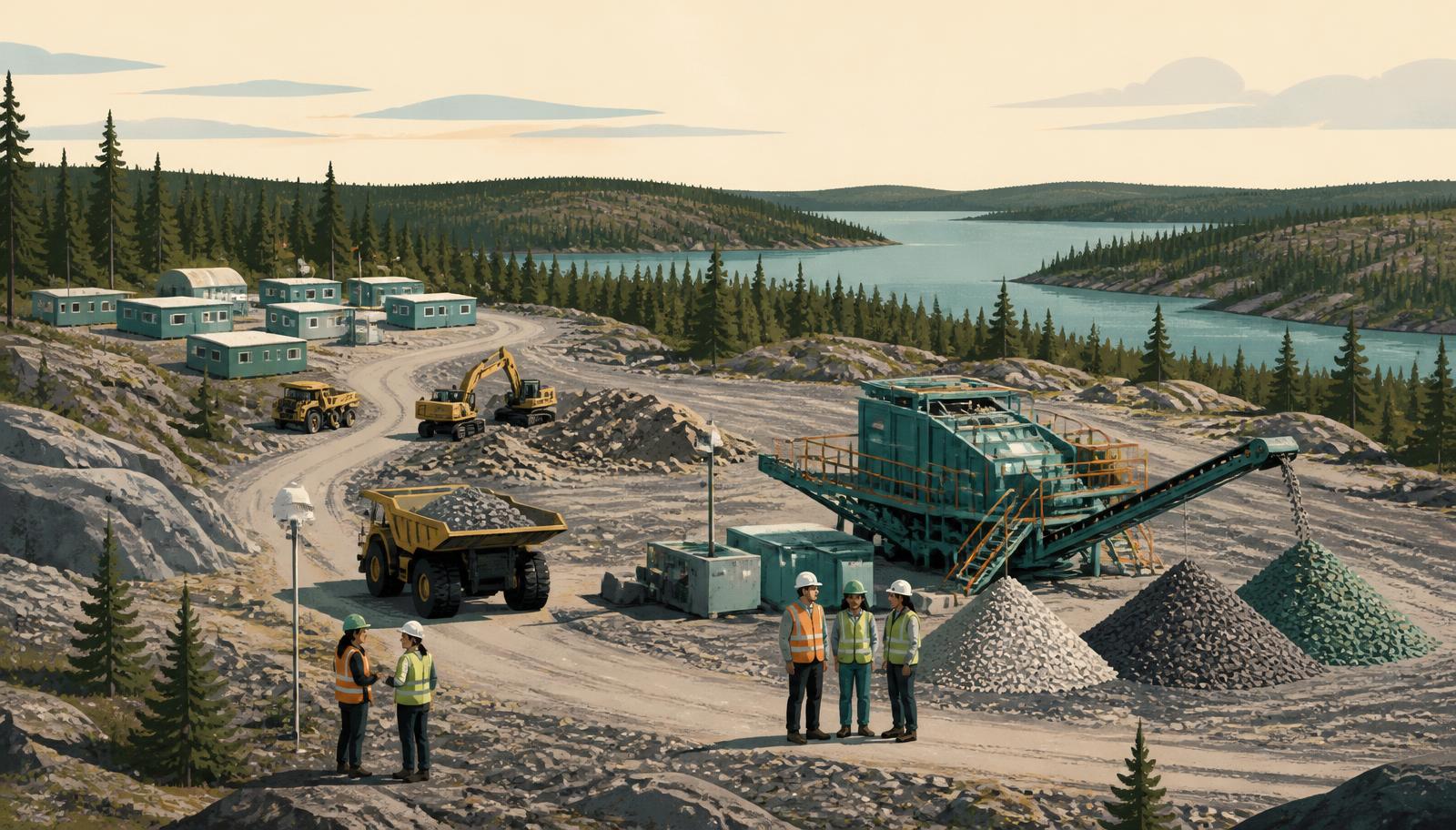
YELLOWKNIFE.The Nechalacho rare earths project, roughly 100 kilometres southeast of Yellowknife on Thor Lake, began shipping concentrate in 2022 as Canada's first domestic source of rare earth elements — minerals used in electric vehicle batteries, wind turbines, and defence electronics, and a category where global supply is heavily concentrated in China. Nechalacho's Tardiff deposit is considered among the highest-grade and largest undeveloped rare earth resources in the world, though the project developed to date has focused on a much smaller near-surface deposit known as North T.
What distinguishes Nechalacho structurally from most Canadian mining projects is not its scale but its operating model. In 2020, Cheetah Resources — the Canadian subsidiary of Australia's Vital Metals — signed a contract with Det'on Cho Nahanni Construction, a company 51%-owned by the Yellowknives Dene First Nation, to conduct the actual mining operations at North T. Company and government sources describe this as the first project in Canada where an Indigenous-owned firm holds the mining contract on its own traditional territory, rather than serving in a subcontracting or service-provision role alongside a non-Indigenous operator. Yellowknives Dene Chief Ernest Betsina said at the time that Indigenous-led mining operations allow communities greater control over environmental safeguarding specifically because the people making operational decisions are also the people whose land and water are affected.
The scale of Nechalacho's demonstration phase has been modest relative to established Arctic and northern mines: roughly 30 to 58 seasonal jobs in its early years, about 70% of the workforce of Indigenous heritage drawn from ten communities, and a physical footprint the company describes as less than one-tenth that of an average Northwest Territories diamond mine. The federal government contributed over $1.2 million toward the demonstration project in 2021 through the Canadian Northern Economic Development Agency, framing the investment explicitly around sustainable mining, Northern employment, and Indigenous economic development rather than production volume. Processing at the site uses sensor-based ore sorting intended to reduce water and diesel use and eliminate the tailings and chemical processing associated with conventional rare earth extraction — a technical choice the operator has tied directly to the sustainability criterion, though it has not yet been tested at a significantly larger production scale.
Assessed against the four-criteria standard, Nechalacho scores most clearly on Indigenous inclusion, where the Det'on Cho mining contract represents a structurally different and more direct form of Indigenous economic participation than a benefit agreement layered on top of a non-Indigenous-operated mine. On regional benefit, the picture is positive but small: meaningful local employment and contracting exist, but at a scale — dozens rather than hundreds of jobs — that limits the project's overall economic weight in the Northwest Territories relative to its diamond mining sector. On national benefit, Nechalacho's significance is more strategic than volumetric at this stage: it demonstrates that Canada can produce rare earth concentrate domestically, which matters for supply chain diversification arguments even before the project reaches a production scale that would materially affect global rare earth markets. On sustainability, the lower-impact processing technology is a genuine point in the project's favour, though it remains unproven at the scale required to develop the much larger Tardiff deposit, should that proceed.
The open question Nechalacho poses for the broader Ring of Fire and Mary River comparisons is whether its Indigenous-led operating model was possible because of the project's small scale, or whether it represents a template that could be replicated at larger, more capital-intensive mines. Vital Metals has stated an intention to eventually offer Indigenous groups an equity stake, beyond the current contracting arrangement, but as of the most recent public reporting that step had not yet been finalized.
Sources
- CBC News, “First Canadian rare earth mine starts shipping concentrate from N.W.T.” (May 2022)
- CBC News, “Dene First Nation subsidiary signs deal to run operations at N.W.T. rare earths mine” (2020)
- Government of Canada news release, “Government of Canada investment supports Indigenous resource development in the Northwest Territories” (June 2021)
- Northwest Territories Industry, Tourism and Investment, “Nechalacho: A First for NWT Mining”
Researched and written by Nowrth staff writers, working from federal department publications, parliamentary and committee records, and peer-reviewed and parliamentary research. Nowrth publishes research and analysis under a collective byline.