Mary River at twenty: The groundwork for unlocking the Arctic's minerals is already built
Two decades of operation have left Canada with high-Arctic mining infrastructure, a documented benefit model and hard-won operating knowledge. Converting that foundation into a durable critical minerals asset is the work of the next decade.
TL;DR
- Mary River has already solved the hardest problems in high-Arctic mining: a producing port, a road system and twenty years of winter operations.
- Its contracting and benefit record, worth over $2 billion to Inuit-owned firms, offers the best documented evidence base of what long-term mineral development delivers in the North.
- Stabilizing the Inuit workforce and earning community support for expansion are the sustained efforts that will determine how much of that groundwork the country can build on.
- As the Arctic moves up the national agenda, Mary River is an early test of whether Canada can turn northern resource projects into nation-building infrastructure.
IQALUIT.Every discussion of Canada's critical minerals future eventually runs into the same practical question: who has actually done this in the Arctic before? Baffinland Iron Mines' Mary River project on north Baffin Island is, at present, the fullest answer. Environmental studies began in 2006, the first Inuit Impact Benefit Agreement with the Qikiqtani Inuit Association (QIA) followed in 2013, and commercial production started in 2014. Twenty years on, it is the longest-running large-scale mining operation in the Canadian Arctic. At a moment when the North sits near the top of the federal agenda, that record reads less like a local industrial story and more like the opening chapter of a much longer nation-building project.
The hardest part is behind it
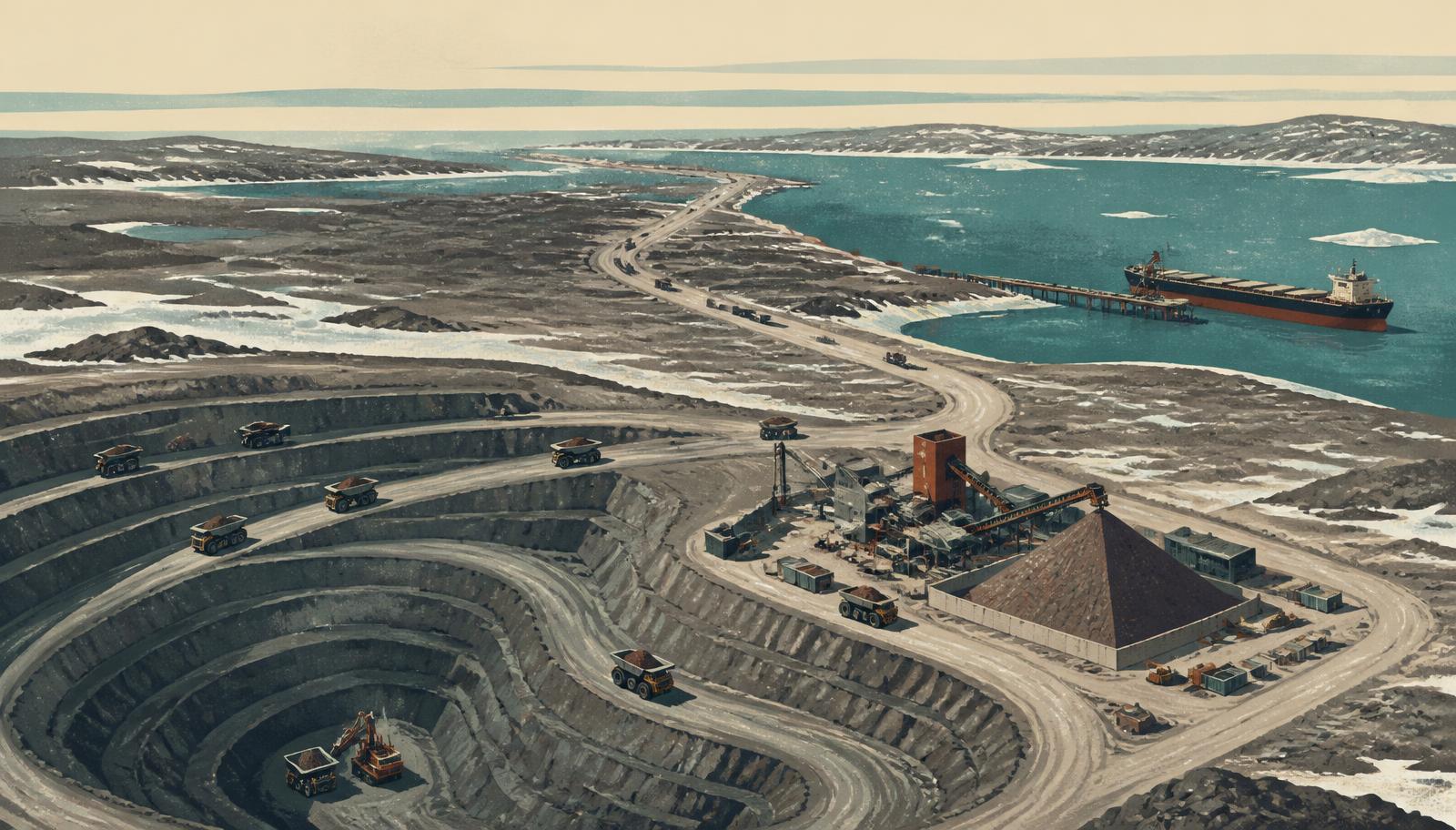
Extracting ore is, in most settings, the routine part of mining. In the high Arctic it is the defining challenge, and Mary River has largely met it. The deposit is high-grade iron ore that ships without processing, which removes an entire industrial layer that would otherwise have to be built and powered above the Arctic Circle. A private haul road of roughly 110 kilometres links the mine to its port at Milne Inlet, and ore carriers load during the open-water season. A proposed railway to a new port at Steensby Inlet would extend shipping toward a year-round schedule.
Each of those elements took years of construction and capital that few projects could assemble twice. Just as important is what cannot be photographed: the accumulated operating knowledge. Mary River's crews have learned how winter haul roads behave, how ice management works at a working port, how a shipping window measured in weeks shapes an entire business plan, and how consultation is conducted in small fly-in communities. That experience is infrastructure in its own right. Any future northern mineral project, whatever mineral it targets, begins from further behind than Mary River stands today.
A benefit model with a documented record
The second asset Mary River offers the country is evidence. In 2020, Baffinland and the QIA signed the Inuit Certainty Agreement, which QIA president P.J. Akeeagok described at the time as putting Inuit in the driver's seat. It provides for Inuit-led environmental monitoring, expanded wildlife compensation, higher royalty payments and daycare funding in affected communities, and Baffinland's president then estimated its value at over $1 billion across the life of the mine.
The financial record since commercial production is substantial. Cumulative contracts with Inuit-owned firms have exceeded $2 billion, and Inuit employees have been paid $214.9 million directly by the company, according to reporting compiled by Nunavut News. Baffinland maintains a formal preference for 100%-Inuit-owned companies on contracts under $3 million within the Qikiqtani region. The record is also honest enough to show strain: Inuit-owned contracting fell from $253 million in 2021 to $153 million in 2025 even as Inuit firms' share of contracts rose from roughly one-third to nearly half, and an independent 2025 assessment for Oceans North found Inuit employment dropped from 20.3% of the workforce in 2014 to as low as 12.5% three years later. Company-reported figures show an average of 320 Inuit employees and contractor workers in 2025, a signal of rebuilding.
That mix of achievement and shortfall is itself useful. Few mining regions anywhere can point to twenty years of audited results showing what benefit agreements actually deliver, and where they fall short of their targets. For policymakers weighing how a critical minerals push in the North should be structured, Mary River is the closest thing to a working case file.
Where the sustained effort goes next
Groundwork, however solid, does not finish the job on its own. The clearest priority is people. The mine's employment history shows that northern workforces do not stabilize by default, and a $12.2 million training centre under construction in Pond Inlet, reported in April 2026, is the kind of investment aimed at that gap. Turning trainees into long-tenured employees, and long-tenured employees into supervisors, is slower work than building roads, and it is where the next decade of the project's contribution will be decided.
The second priority is trust. Baffinland's proposed Phase 2 expansion would roughly double production, and the Steensby rail and port component remains under review. Hunters' and trappers' organizations in Igloolik and Sanirajak told the Canadian Transportation Agency in 2025 that consultation on the Steensby component felt piecemeal, despite 48 in-person sessions Baffinland reported since 2023 on vessel routing and on caribou, marine mammal and land-use protections. The Nunavut Impact Review Board's recommendation against an earlier production increase, accepted by the federal minister in 2022, showed that expansion must be earned through demonstrated benefit rather than assumed. That discipline is a feature of the northern regulatory framework, and the projects that navigate it successfully will be more durable for having done so.
A limb of the larger project
The wider context gives this story its national weight. Canada's 2024 Arctic Foreign Policy, the critical minerals strategy and the defence commitments now reshaping the North all point in the same direction: the Arctic has become a first-order priority, and priorities of that scale are pursued through infrastructure that lasts generations. Nation-building in the North has always proceeded this way, through patient and cumulative work rather than a single announcement.
Mary River is where that work has already been done once. The mine exists, the port operates, the benefit agreements are signed and functioning. The evidence of what works is on the record. Whether the coming decade builds on that foundation, with a stable Inuit workforce and an expansion the region genuinely supports, will say a great deal about how Canada's Arctic century begins.
Sources
- Nunavut News, “Nunavut Mining: $12.2 million Pond Inlet training centre under construction” (April 2026)
- CBC News, “New Inuit benefit agreement worth $1B over life of Mary River Mine” (July 2020)
- Oceans North, “Assessment of the Mary River Project: Impacts and Benefits” (2025)
- The Narwhal, “Baffinland expansion in Arctic challenged by Nunavut hunters” (2026)
- Natural Resources Canada, “The Canadian Critical Minerals Strategy”
- Global Affairs Canada, “Canada's Arctic Foreign Policy” (2024)
Researched and written by Nowrth staff writers, working from federal department publications, parliamentary and committee records, and peer-reviewed and parliamentary research. Nowrth publishes research and analysis under a collective byline.